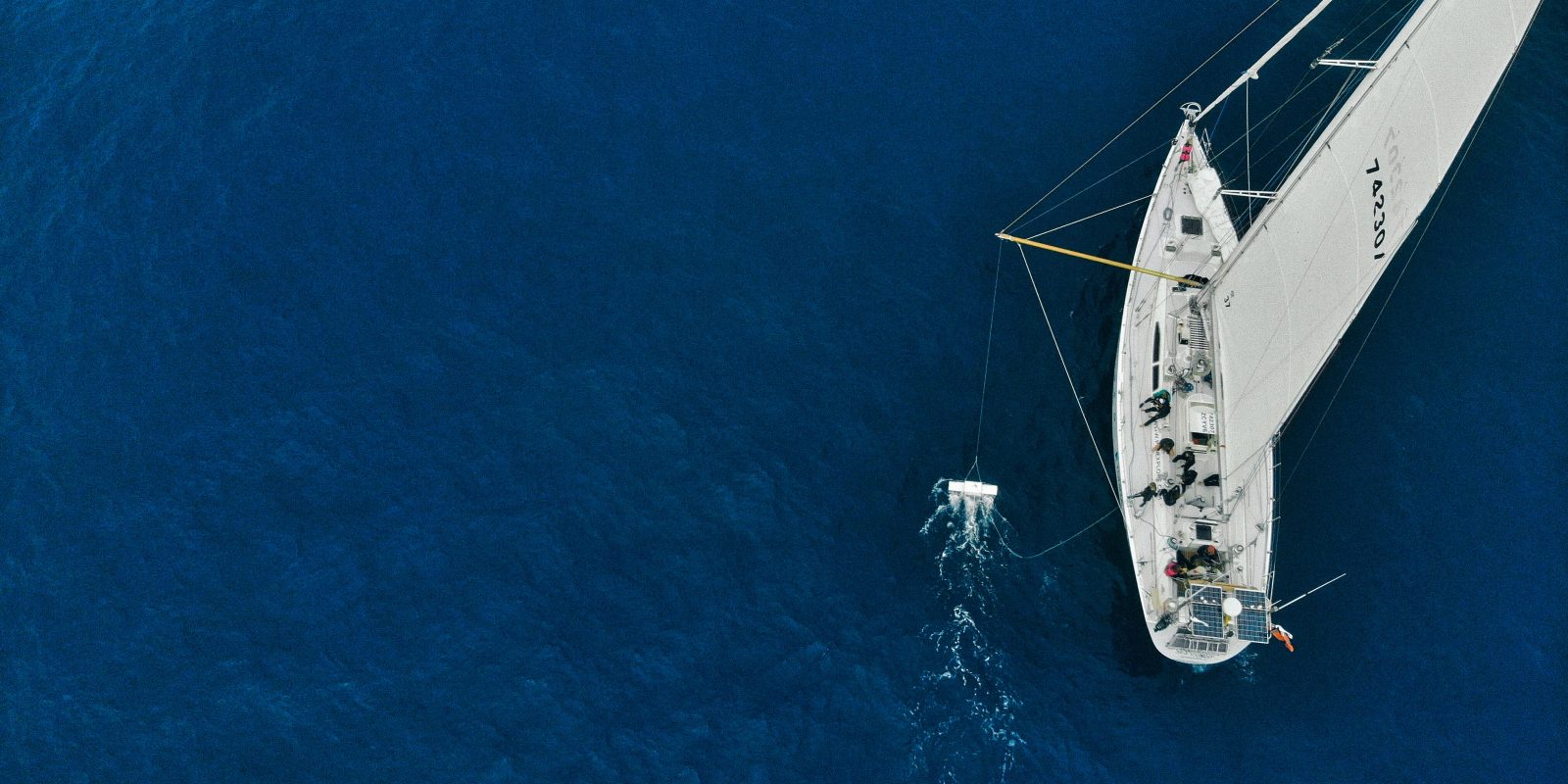

An all-women sailing expedition sets sail today on a mission to deliver the first global study mapping ocean plastic pollution back to its sources on land. Departing from Auckland, this first part of the voyage will sail across the South Pacific from New Zealand to Tonga.
Led by the British environmental organisation eXXpedition and renowned ocean advocate Emily Penn, the mission will fill critical gaps in our understanding of where ocean plastic comes from – and help pinpoint the most impactful solutions.
“Plastic is polluting our entire ocean – and even our bodies – but the sources of that pollution differ,” said Emily Penn, eXXpedition Founder. “It’s a global problem, but there’s no single-fix. It needs local industry-specific, diverse solutions.”
The global expedition consists of 10 legs and 10 teams. With the first three legs fully crewed, today’s launch also opens applications for the remaining voyages – visiting the Arctic, Antarctica, Caribbean and North Pacific throughout 2026 and 2027. The last time eXXpedition set sail, over 10,000 women applied for just 300 crew places.
Why this matters now
The expedition comes at a critical moment for global ocean health and environmental policy. Despite widespread awareness, plastic pollution continues to accelerate:
- An estimated 171 trillion plastic particles are now floating in the world’s ocean – up from around 5 trillion in 2014.
- Talks for a UN Global Plastics Treaty stalled in August 2025, leaving no binding global limits on plastic production or toxic additives.
- Corporate sustainability funding has fallen sharply, with companies scaling back their environmental teams and commitments.
With global progress not moving fast enough, the mission aims to strengthen the evidence base and create the agency and momentum needed to drive action. All results will be made freely available through an interactive, open-access global data platform. The expedition’s findings are also expected to inform international discussions, including those linked to the UN Global Plastics Treaty.
From local insights to a global picture
The mission will build on insights from eXXpedition’s previous Round the World voyage (2019–2021), which linked human activities with plastic pollution found in nearby waters. For example, microplastic samples collected in Antigua were dominated by paint and acrylic particles, which the team traced back to the local boatyard activities.
This year’s expedition will scale that approach globally, combining findings into a comprehensive map showing how plastic moves from land into the ocean and travels all around the world.
The resulting visualisation will highlight areas already most burdened – and most at risk – helping to prioritise prevention, cleanup and policy interventions.

State-of-the-art science at sea
During the upcoming mission, crew members will use state-of-the-art equipment at sea – including the portable Spectrum Two FT-IR Spectrometer from PerkinElmer – to collect and analyse microplastics in surface ocean water and identify polymer types. Because each polymer has a unique chemical fingerprint, this in turn allows scientists to match fragments to their source materials.
On land, the team will complete the picture by conducting investigations into litter, consumer goods and waste management infrastructure. They will also work with local experts to gather further insight and identify opportunities to reduce or prevent plastic pollution.
In Penn’s words, “Our mission is to scientifically determine the source of specific pieces of plastic we find in the ocean – right back to where they came from. Which shop shelf? Which brand? With that knowledge, we can start designing and delivering solutions that really work.”.
Collaboration with University of Georgia’s Circularity Informatics Lab
The scientific research will be led by the University of Georgia’s Circularity Informatics Lab in the United States, under the direction of Professor Dr Jenna Jambeck – a crew member of a previous eXXpedition mission. After her trip, Dr Jambeck went on to publish groundbreaking research that became one of the most cited papers ever on plastic pollution.
Crucially, the research on this mission will be conducted in collaboration with scientific partners, local communities and leaders in each region.
“Data is power – and it is crucial to get data into the hands of people who need it to make decisions,” said Dr Jambeck.
A crew as diverse as the solutions required
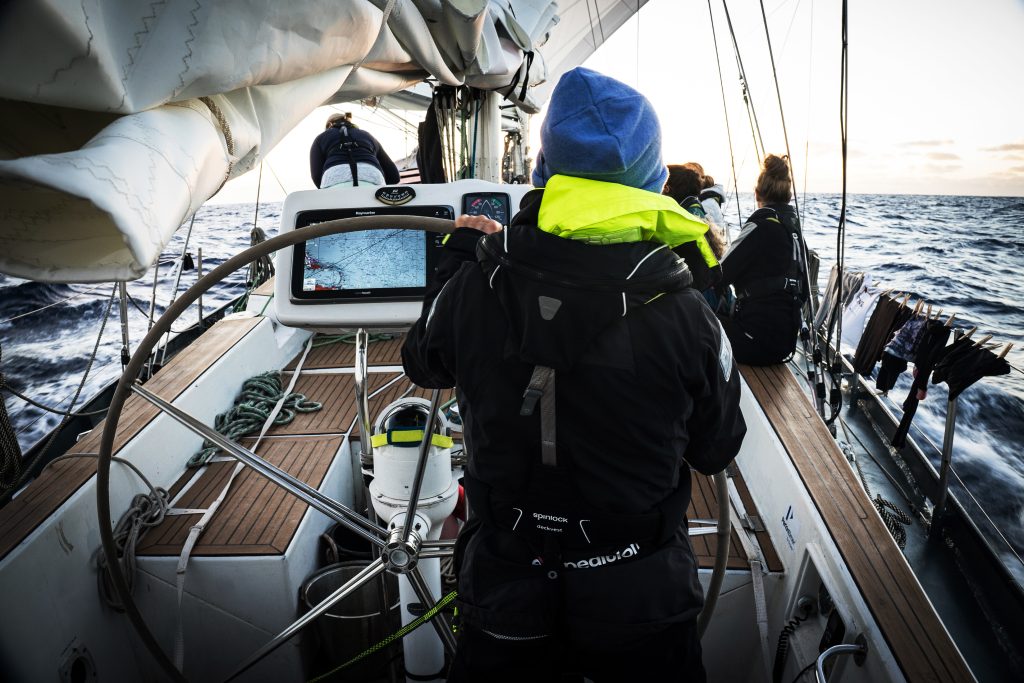
This mission – like all of eXXpedition’s voyages – will be crewed by multidisciplinary women from across the globe, most of whom have no sailing experience. The first crew members include an engineer from Bulgaria, an entrepreneur from Austria, a materials innovator from the Netherlands, a marine biologist from Oman, a tech specialist from Germany, a waste management expert from Norway, a policy advisor from the UK, and a product supply chain director from the US.
The diversity of the crew is wholly intentional. In Penn’s words, “Everyone has a role to play in solving the plastic crisis. We want to get as many people as possible – with diverse skills, backgrounds and influence – to connect with the plastic problem and fulfil their unique role in tackling it.”
Since eXXpedition’s founding in 2014, 274 women aged 18–70 from 41 nations have joined 29 missions. Along the way, these women have partnered with hundreds of organisations, contributed data to 35 scientific studies and generated over 2,000 media interviews.
Route map
The global expedition is made up of 10 legs, listed below, with more added as time goes on. Although the first three trips are fully crewed, eXXpedition is looking for more women to join the rest of the trip.
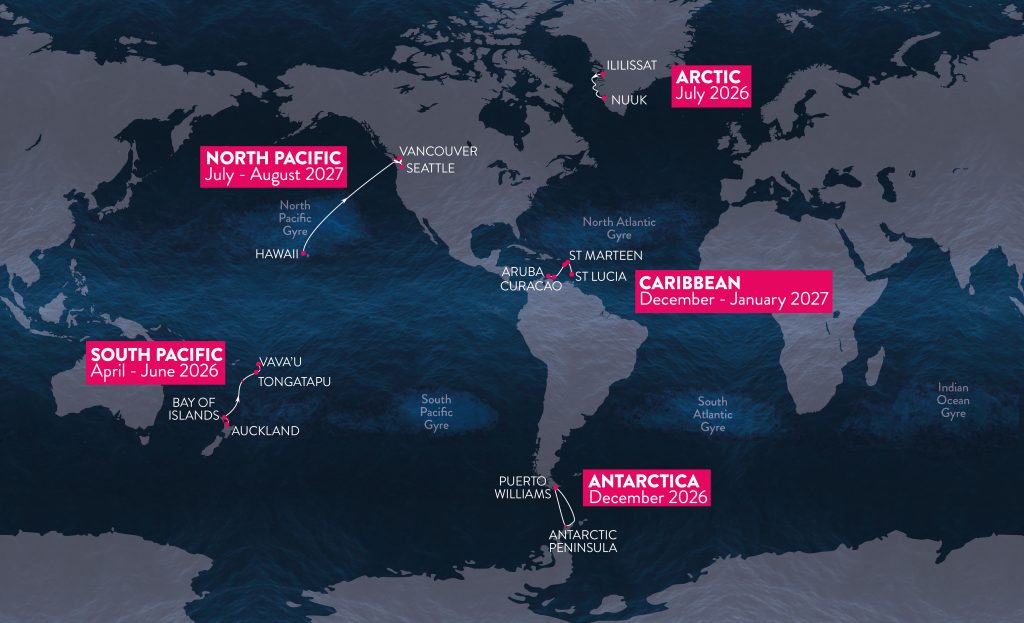
South Pacific I : Auckland to Bay of Islands | 27th April – 6th May 2026
South Pacific II: Bay of Islands to Nuku’alofa | 11th May – 27th May 2026
South Pacific III: Nuku’alofa to Vava’u | 2nd June – 11th June 2026
Arctic: Disko Bay to Nuuk | 12th July – 19th July 2026
Antarctica: Puerto Williams to Antarctic Peninsula | 28th November – 19th December 2026
Caribbean I: St Lucia to St Maarten | 28th December – 3rd January 2027
Caribbean II: St Maarten to Curação | 7th January – 14th January 2027
Caribbean III: Curaçao to Aruba | 18th January – 26th January 2027
North Pacific I: Hawaii to Vancouver | 15th July – 7th August 2027
North Pacific II: Vancouver to Seattle | 13th August – 20th August 2027
Media contact and interview requests
For more information about this news release or to arrange an interview with the eXXpedition team, UGA team or former/future guest crew please contact [email protected].
Meet our Partners
These expeditions are made possible by crew contributions, sponsorships and partnerships. Thank you to our current partners: Kensington Tours, University of Georgia, The Commonwealth, PerkinElmer, 1% for the Planet, University of Auckland, 5 Gyres Institute, Sustainable Coastlines, Chandler and Partners, Sail Seven Seas, Panexplore.
Find out more here.
Follow us across eXXpedition’s social channels
